
Bootstrapping vs Venture Capital: Which Funding Path Fits Your Startup? 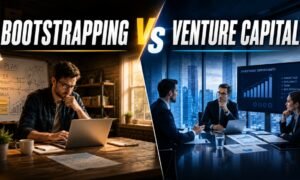
Starting up a business can be thrilling, but ideas need to be developed into products, and this requires capital. The choice of how to finance a venture is one of the most crucial ones that must be made by its founders. Some entrepreneurs opt to rely on their own resources to fund their business, while other seek investment from venture capitals. These options have different implications for the development of the venture, its growth, and decision-making.
The debate between bootstrapping and venture capital is not about which one is better but rather which is appropriate for a given venture. Both these options have advantages and disadvantages and can be preferred depending on the industry, business plan, and goals of the entrepreneur. The choice between venture capital and bootstrapping is one of the most vital that must be made when starting a business.
Bootstrapping: Overview of Concepts
In general, bootstrapping is a process of starting and developing a venture using the entrepreneur’s own resources. It is important to note that in this case, the ownership of the business remains intact. Bootstrapping does not prevent an entrepreneur from seeking additional investment, but he or she relies mostly on personal savings and expenditures to grow the business. Many successful companies were built through bootstrapping.
Venture Capital: Overview of Concepts
When speaking about venture capital, it is necessary to highlight that it represents a type of financing provided by investors. Such investors are interested in the growth of the value of the startups in which they decide to invest. The majority of venture capitalists are professional investors, meaning that they are not ordinary individuals but companies that specialize in this kind of activity. It is also vital to understand that apart from funding, venture capitalists can offer expertise, mentoring, connections, and other forms of support.
The Discussion of the Concepts Presented
The choice between bootstrapping and venture capital often becomes essential when a venture begins to contemplate scaling. In this respect, it is important to note that both options have advantages and disadvantages, and their importance depends on the goals of the entrepreneur and the characteristics of the venture itself.
Growth Speed Versus Business Control
One of the most noticeable differences between the two funding methods lies in the balance between growth and ownership.
Bootstrapped businesses usually expand at a measured pace because growth depends largely on available revenue. This encourages founders to prioritize profitability, efficient operations, and customer satisfaction from the beginning. Every spending decision receives careful consideration since resources are limited.
Companies backed by venture capital often grow much faster. Significant funding allows startups to hire larger teams, invest aggressively in marketing, accelerate product development, and enter multiple markets simultaneously. Speed becomes a competitive advantage, particularly in technology-driven industries where being first can determine long-term success.
However, faster growth comes with shared ownership. Venture investors typically gain equity and influence over major business decisions. Founders may no longer have complete control over the company’s direction, hiring strategies, fundraising plans, or eventual exit opportunities.
This tradeoff defines much of the conversation around bootstrapping vs venture capital, as entrepreneurs must decide how much independence they’re willing to exchange for accelerated growth.
Financial Risk and Long-Term Sustainability
Funding choices also influence financial discipline and business resilience.
Bootstrapped companies often develop strong financial habits because every dollar matters. Since founders rely on customer revenue instead of investor funding, they tend to focus on creating products that generate immediate value. This customer-first mindset can result in healthier cash flow and sustainable operations over time.
Venture-funded startups operate under different expectations. Investors typically prioritize rapid expansion and market share over short-term profitability. Companies may intentionally operate at a loss while investing heavily in product innovation, customer acquisition, and infrastructure. If growth targets are achieved, future funding rounds can support continued expansion until profitability becomes realistic.
Nevertheless, external funding introduces additional pressure. Investors expect measurable progress, increasing valuations, and eventual liquidity through acquisition or public listing. Missing these milestones can make future fundraising significantly more challenging.
Considering these financial realities is essential when evaluating bootstrapping vs venture capital because each model creates different incentives and performance expectations.
Which Funding Model Is Right for Your Startup?
There is no single formula that guarantees success. The ideal funding strategy depends on several business-specific factors.
A startup operating in software,artificial intelligence, biotechnology, or advanced technology may require substantial capital before generating meaningful revenue. Research, product development, regulatory approvals, and market expansion often demand investments that exceed what founders can finance independently. Venture capital can provide the resources necessary to compete effectively in these industries.
Conversely, businesses with lower startup costs, predictable customer demand, or service-based models may thrive through bootstrapping. Consultants, agencies, online businesses, local services, and many niche software companies often achieve steady profitability without sacrificing ownership.
Founder preferences also play a major role. Some entrepreneurs value complete decision-making authority and prefer growing at their own pace. Others are comfortable sharing ownership if it allows them to pursue ambitious expansion goals that would otherwise be impossible.
Ultimately, choosing between bootstrapping vs venture capital requires balancing personal ambitions with realistic business requirements rather than following industry trends.
Making a Smart Funding Decision
Funding is more than simply securing money—it influences company culture, leadership, operational strategy, and future opportunities. Entrepreneurs should carefully evaluate how much capital they truly need, how quickly they want to grow, and what level of ownership they wish to retain.
Neither approach guarantees success, nor does either guarantee failure. History is filled with profitable bootstrapped companies as well as venture-backed startups that transformed entire industries. Likewise, both models have examples of businesses that struggled despite adequate funding.
The smartest founders begin by understanding their market, validating customer demand, and creating a realistic financial roadmap before selecting a funding strategy. When the funding model aligns with the company’s objectives and the founder’s long-term vision, the business is better positioned to navigate challenges and capitalize on future opportunities.