
Predictive Analytics Dashboard: Turning Business Data into Smarter Decisions 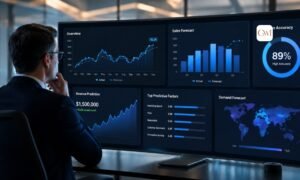
Modern organizations produce an incredible amount of data on a daily basis. From customer interaction records to sales and marketing details, all activities generate some data. However, statistics alone are not enough, and businesses need some way to effectively organize and analyze it all. This is where a predictive analytics dashboard comes in handy.
It allows companies to take advantage of all existing information and base their business decisions on evidence and past trends instead of blind guesses. By combining data mining, statistics, and machine learning, predictive analytics can do much more than just report what has already happened – it can predict future events and help organizations avoid potential problems while taking advantage of emerging opportunities.
The Purpose of Predictive Analytics Dashing
Standard dashboards and reports show businesses what has already happened. They demonstrate the current situation and help organizations understand what happened in the past. With this information, companies can make educated decisions about the future, but it is hard to get the necessary level of detail and plan all potential outcomes. Predictive analytics dashboards allow businesses to do just that, and this is their primary purpose.
Such a dashboard is essentially a powerful set of analytical tools that can assess past trends and patterns and predict future trends. This way, organizations can be several steps ahead of their competitors and successfully plan their strategies rather than randomly stumbling into opportunities or being caught off-guard by some of the most common issues. A predictive analytics dashboard is essentially a set of intuitive visualizations that can help analyze the data as well as predict future trends. This eliminates the need to pore over multiple documents and reports trying to get some understanding of how the future might unfold.
Organizations across industries rely on predictive models for a wide variety of use cases. Retailers estimate seasonal demand, healthcare providers anticipate patient admissions, manufacturers predict equipment failures, and financial institutions evaluate credit risks. Regardless of the industry, the objective remains the same: making informed decisions backed by reliable data.
Key Features That Make Predictive Dashboards Effective
A well-designed predictive analytics dashboard does much more than display colorful charts. It integrates data from multiple sources, processes information automatically, and delivers forecasts that update as new information becomes available.
One of its strongest capabilities is real-time monitoring. Rather than relying on static reports generated once a month, businesses gain continuous visibility into changing trends. As fresh data enters the system, predictions evolve, allowing managers to adjust their strategies without waiting for the next reporting cycle.
Another essential feature is interactive visualization. Users can filter results by location, product category, customer segment, or time period to uncover hidden relationships within the data. These visual elements simplify complex statistical findings, making them accessible even to non-technical stakeholders.
Modern dashboards also support automated alerts. If projected sales drop below expectations or customer churn rises beyond acceptable limits, the system can immediately notify relevant teams. Early warnings help organizations respond quickly before small issues become larger business problems.
Equally important is integration with business intelligence platforms and cloud-based databases. Instead of maintaining isolated systems, organizations can connect operational data, customer information, and financial records into a unified analytical environment. This creates more accurate predictions and eliminates inconsistencies between departments.
Business Benefits Across Different Industries
The adoption of predictive analytics has expanded rapidly because organizations increasingly recognize its measurable business value. Companies no longer compete solely on products or services; they compete on how effectively they use data to guide decisions.
Sales teams benefit by forecasting revenue more accurately and identifying high-potential prospects. Marketing departments use predictive insights to personalize campaigns, optimize advertising budgets, and improve customer retention. Operations managers can anticipate supply chain disruptions and optimize inventory levels, reducing unnecessary costs.
Customer service departments also gain valuable advantages. By analyzing previous interactions and behavioral patterns, businesses can identify customers who may require additional support or those likely to discontinue a service. Proactive engagement often leads to higher customer satisfaction and stronger long-term loyalty.
Financial planning becomes more reliable as organizations use a predictive analytics dashboard to estimate cash flow, identify potential risks, and evaluate investment opportunities. Rather than depending solely on intuition, executives gain quantitative evidence to support strategic planning.
Healthcare organizations apply predictive analytics to improve patient outcomes by identifying individuals at higher risk of complications. Educational institutions forecast student performance and allocate resources more efficiently. Manufacturing companies reduce downtime through predictive maintenance, scheduling repairs before equipment fails unexpectedly.
Across these industries, the common advantage is better preparation. Businesses that anticipate future events generally respond faster and make more confident decisions than those relying only on historical reports.
Choosing the Right Dashboard for Long-Term Success
Selecting the right analytics solution requires more than evaluating visual appeal. Organizations should first identify the business questions they want to answer and ensure the platform supports those objectives.
Ease of use plays a significant role in successful adoption. Even the most advanced analytical tools lose value if employees struggle to interpret the results. Intuitive navigation, customizable reports, and user-friendly interfaces encourage wider usage across departments.
Scalability is another critical consideration. As businesses grow, data volumes increase substantially. A predictive analytics dashboard should accommodate expanding datasets without sacrificing performance or accuracy. Cloud-based platforms often provide greater flexibility, allowing organizations to scale resources according to demand.
Data quality should never be overlooked. Predictive models are only as reliable as the information they analyze. Businesses must establish consistent data governance practices, remove duplicate records, and maintain accurate datasets to ensure dependable forecasts.
Security and compliance also deserve attention, particularly for industries handling sensitive customer or financial information. Robust access controls, encryption, and regulatory compliance features help protect valuable business data while maintaining trust with customers and stakeholders.
Ultimately, organizations should view predictive analytics as an ongoing business capability rather than a one-time technology investment. As new data becomes available, forecasting models continue to improve, delivering increasingly accurate insights that support better decision-making over time.
A thoughtfully implemented predictive analytics dashboard empowers organizations to move beyond reactive reporting and embrace forward-looking strategies. By transforming historical information into meaningful forecasts, businesses gain greater confidence in planning, reduce uncertainty, and uncover opportunities that might otherwise remain hidden. In an increasingly competitive marketplace, the ability to predict future outcomes has become a significant advantage, helping organizations make faster, smarter, and more informed decisions while positioning themselves for sustainable long-term growth.