
The Virtual Environments Used to Train Robots
A staff worker offers a plastic bottle to Freddo the robot, who crosses the office and accepts it. It’s not the most remarkable accomplishment, considering that a robot recently broke Usain Bolt’s 100-meter sprint record.
However, it’s amazing how quickly Freddo has been trained to move, identify the bottle, and grab it. Developing those abilities and uploading them to Freddo only took a few minutes. According to his inventors, competing systems might require days to acquire such abilities.
I work for Vsim, a Cambridge-based British start-up. Michelle Lu and Kier Storey, the company’s founders, expect that their software could eventually enable robots to navigate and do practical activities at home and at work. However, there is still more work to be done.
“It’s a strange situation with robotics because you can actually get robots to perform rather well at things that humans find really difficult, like gymnastics. Robots struggle greatly with tasks that humans excel in, such as fine dexterity, according to Storey.
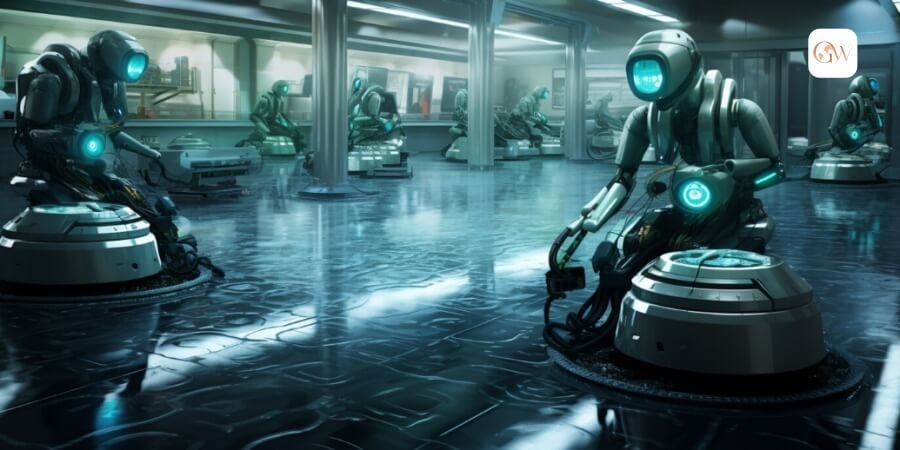
Freddo the robot is supported by founders Michelle Lu and Kier Storey. In a virtual setting, where a task can be completed millions of times in a computer simulation, Freddo developed his skills. The hardware, in this case Freddo, can upload and utilize the optimal solution (referred to as a policy) once it has been identified.
Robots are frequently trained using these kinds of virtual simulations. Lu and Storey both worked on an early version of Nvidia’s Isaac Sim technology, which operates in this manner.